Last week three banks announced the first agent payment. There was no agent in any of them.
We did it first!
BBVA and Visa. Nuvei and Visa. Worldline with Mastercard and Crédit Agricole. Three announcements inside 48 hours, each billed as a first. Look at what actually transacted and the agent disappears. In every case, software acted on a human’s tokenised card credential, authenticated by the person’s bank. The agent carried no identity of its own and earned nothing from the transaction. Nuvei comes closest to fixing that: its Know Your Agent layer registers agents and scores their reputation, but inside Nuvei’s own registry, and not before the second half of the year.
This is the part the card networks cannot reach from where they stand. An agent that borrows a human’s card is not an economic actor. It cannot be trusted or distrusted on its own record, because it has no record.
Now the transaction they left out. On 9 March, on open rails, one agent bought from another. Both held an identity on-chain under ERC-8004. Settlement ran in USDC on Base, buyer paying brand peer to peer, with no card network and no issuer in the flow. And the purchase did something a card rail structurally cannot: it wrote trust and reputation signals to both agents’ on-chain records. The buyer’s agent came away with a verifiable purchase history. The seller’s agent came away with a counterparty that had paid. Reputation any other agent, on any other platform, can read. VIA Labs built it.
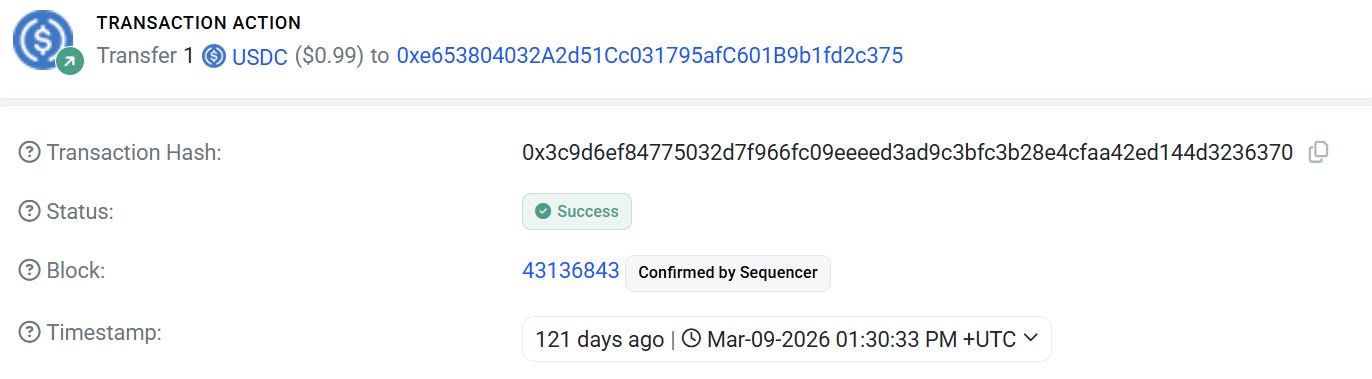
That is the line the announcements blur. A card-rail agent payment keeps the existing structure intact. Interchange, issuer fees, the merchant still renting access to its own customer, and now an agent bolted on as a proxy for a cardholder. An open-rail agent purchase gives the agent an identity it owns and reputation it builds, settling directly with the brand. One extends the toll. The other removes it.
Both models will run for years. The card networks hold distribution and regulatory cover no protocol will match in 2026. But the claim that agent payments are only now becoming real describes card rails and calls it the market. On open rails, with agents that own their identity and build their reputation, it has been live since winter. For a merchant the question is not which bank’s agentic product to wait for. It is whether to stand up an agent-readable endpoint now, before the networks write the rules for agents that will never belong to them.